
OLD GAMES · NEW MEMORIES
Play
Again.
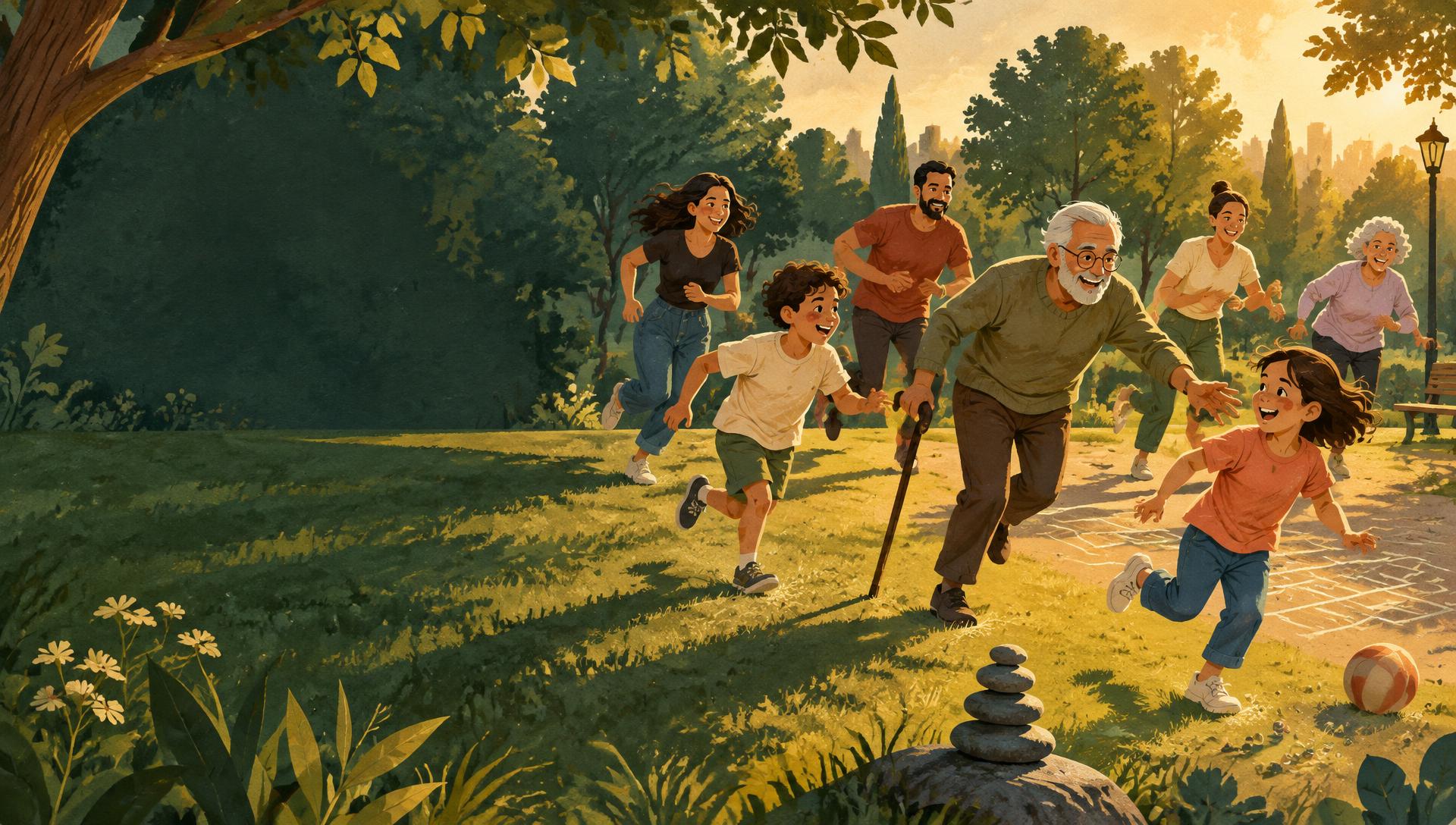
The games that filled our streets and afternoons are waiting for us—children, grown-ups and grandparents together.
THE GAMES ARE STILL HERE
One ball. Seven stones. A whole afternoon.
Before play needed a screen, it needed only a few people and a little imagination. These games belong in our parks, lanes and lives again—with room for every generation.
PLAY HAS MANY NAMES
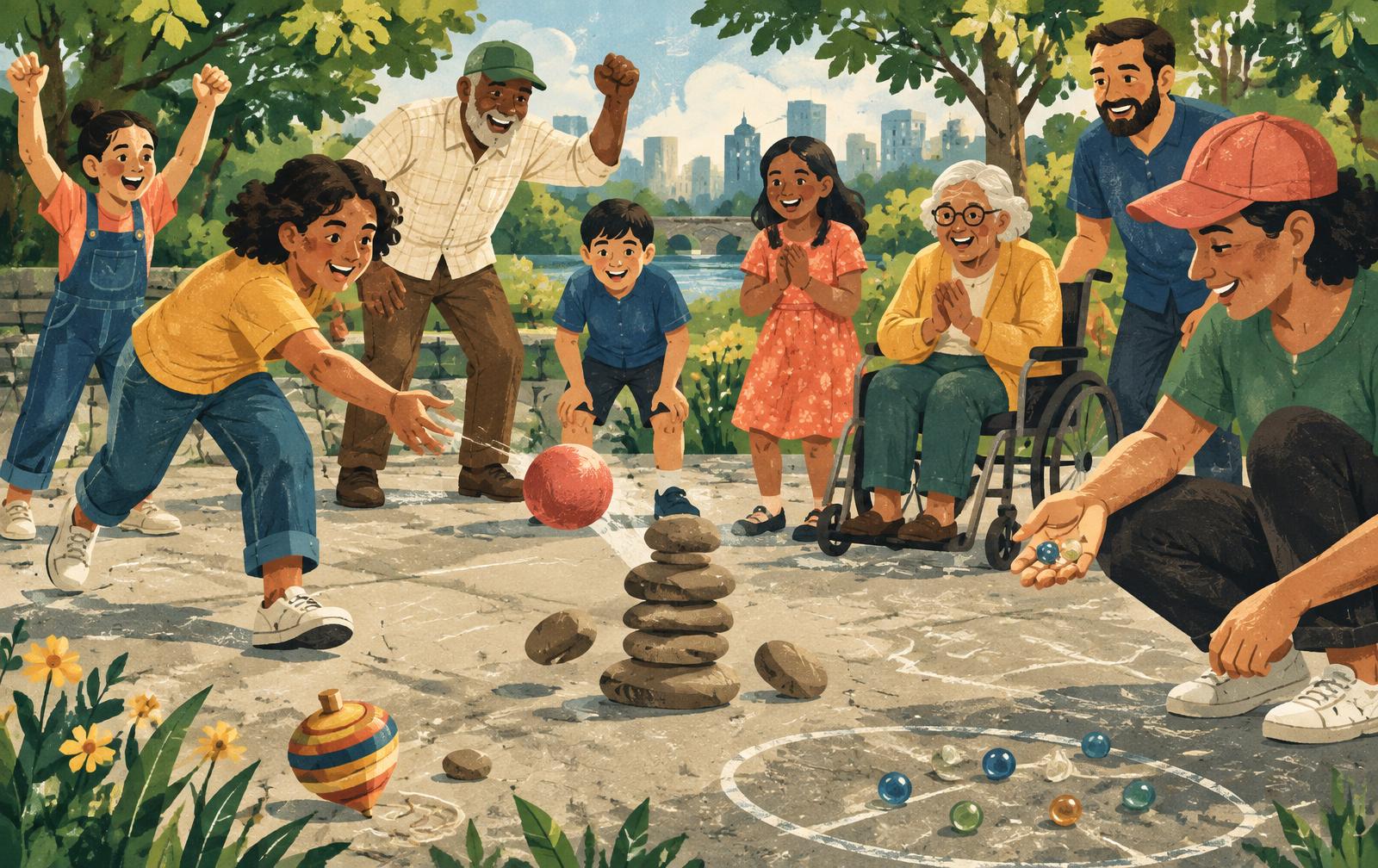
Pakad-pakdi is tag. Aankh-micholi is hide-and-seek.
Names change from lane to lane and language to language. The feeling is familiar: someone counts, someone runs, everyone laughs, and the day becomes a memory.
ways to play
welcome here
THE PLAY LIBRARY
What shall we play today?
Search by the name you remember, or choose the kind of afternoon you want.
33 games ready to rediscover
Run & chase
Pakad-pakdi
Tag · Chase · Pakdam-pakdai
Run & chase
Pakad-pakdi
Tag · Chase · Pakdam-pakdai
- Choose one chaser.
- Run within agreed boundaries.
- A gentle tag makes the tagged player the new chaser.
Bring: Nothing
Play it your way: Walk, wheel or use a soft scarf for tagging. Nobody is eliminated.
Play safely: Agree on no-go areas and use a clear, obstacle-free space.
A familiar Indian name for the worldwide family of tag and chase games.
Run & chase
Aankh-micholi
Hide-and-seek · Lukka-chuppi
Run & chase
Aankh-micholi
Hide-and-seek · Lukka-chuppi
- One seeker counts at base.
- Everyone else hides inside the boundary.
- The seeker finds players while hiders try to return safely.
Bring: A safe base
Play it your way: Try reverse hide-and-seek: one person hides and everyone quietly joins them.
Play safely: Choose visible, safe hiding zones and never hide near roads or water.
Run & chase
Kho-kho
Kho Kho
Run & chase
Kho-kho
Kho Kho
- Make a central lane with seated chasers facing alternate ways.
- One active chaser pursues the runners.
- Pass the chase by touching a teammate and calling “Kho”.
Bring: Cones or chalk
Play it your way: Shorten the lane, slow the pace, or pass a scarf instead of tagging.
Play safely: Warm up first and keep the turning posts padded or clearly marked.
One of India’s best-known traditional team tag games.
Source: Khelo India
Run & chase
Chain tag
Chain-chain · Link tag
Run & chase
Chain tag
Chain-chain · Link tag
- One person begins as chaser.
- Tagged players join hands with the chaser.
- The growing chain works together to tag everyone.
Bring: Nothing
Play it your way: Use pairs instead of one long chain, or play at walking pace.
Play safely: Let go immediately if the chain pulls or twists.
Run & chase
Chor-police
Thief and police · Cops and robbers
Run & chase
Chor-police
Thief and police · Cops and robbers
- Split into chasers and runners.
- Mark a home base and a friendly “jail”.
- Tagged runners return when freed by a teammate.
Bring: Team markers
Play it your way: Use a short timed round and swap roles so everyone gets a turn.
Play safely: Keep the story playful; no grabbing, tackling or rough restraint.
Run & chase
Red Light, Green Light
Statues · Traffic lights
Run & chase
Red Light, Green Light
Statues · Traffic lights
- One caller faces away.
- Move on green and freeze on red.
- Reach the caller without being seen moving.
Bring: Nothing
Play it your way: Every kind of movement counts—steps, wheels, gestures or claps.
Aim & strike
Kanche
Marbles · Kancha · Goti
Aim & strike
Kanche
Marbles · Kancha · Goti
- Draw a small circle and place marbles inside.
- Take turns flicking a shooter marble from behind a line.
- Score each marble knocked outside the circle.
Bring: Marbles and chalk
Play it your way: Use beanbags or larger soft balls and a short rolling ramp.
Play safely: Marbles are a choking hazard; supervise young children.
Marble games have ancient parallels across many civilizations.
Aim & strike
Lagori
Seven Stones · Pithu · Satoliya
Aim & strike
Lagori
Seven Stones · Pithu · Satoliya
- Stack seven flat stones.
- One team knocks the stack down with a ball.
- Rebuild it before the other team tags players with the ball.
Bring: 7 flat stones, soft ball
Play it your way: Use foam blocks, underarm rolls and a buddy builder.
Play safely: Use only a soft ball and aim below the waist.
Known by many regional names across South Asia.
Aim & strike
Gilli-danda
Tipcat · Vitti-dandu · Kitti-pul
Aim & strike
Gilli-danda
Tipcat · Vitti-dandu · Kitti-pul
- Place the short tapered gilli on the ground.
- Tap it upward with the long danda.
- Strike it for distance while fielders try to catch it.
Bring: Danda and gilli
Play it your way: Use a foam gilli and paddle, with close scoring zones.
Play safely: Create a wide no-entry striking zone; adults supervise children.
An old bat-and-stick game of the Indian subcontinent.
Aim & strike
Gully cricket
Street cricket · Cricket
Aim & strike
Gully cricket
Street cricket · Cricket
- Agree on local boundaries and one simple wicket.
- Each player bats for a set number of balls.
- Rotate batting, bowling and fielding often.
Bring: Bat, soft ball, improvised wicket
Play it your way: Use underarm bowling, a wide bat, runners or seated batting.
Play safely: Use a tennis or foam ball away from traffic and windows.
Aim & strike
Lattu
Spinning top · Bambaram · Buguri
Aim & strike
Lattu
Spinning top · Bambaram · Buguri
- Wind the string around the top.
- Throw and pull the string to set it spinning.
- Try longest spin, a marked circle or simple tricks.
Bring: Top and string
Play it your way: Use a pump-action top or help one another wind the string.
Play safely: Give each spinner a clear circle.
Aim & strike
Ring toss
Quoits
Aim & strike
Ring toss
Quoits
- Place a target at a comfortable distance.
- Take turns tossing three rings.
- Move the line until the challenge feels just right.
Bring: Soft rings, target
Play it your way: Use larger rings, floor targets or a partner-assisted toss.
Aim & strike
Soft-bowl target
Target roll
Aim & strike
Soft-bowl target
Target roll
- Arrange light targets in a cluster.
- Roll or toss from a marked line.
- Reset together after every round.
Bring: Soft ball, bottles
Play it your way: Play seated, change target sizes and remove scoring entirely.
Lines & balance
Stapu
Hopscotch · Kith-kith · Ekhat-dukat
Lines & balance
Stapu
Hopscotch · Kith-kith · Ekhat-dukat
- Draw a numbered court.
- Toss a marker into the next square.
- Travel through the court without touching that square or the lines.
Bring: Chalk, flat marker
Play it your way: Step, wheel, tap or point through enlarged squares instead of hopping.
Play safely: Keep the surface dry and the court away from vehicles.
Lines & balance
Skipping rope
Jump rope · Rope circle
Lines & balance
Skipping rope
Jump rope · Rope circle
- Turn the rope at an easy rhythm.
- Step or jump in when ready.
- Add a rhyme or count together.
Bring: Soft rope
Play it your way: Wave the rope low, step over it, or turn for others without jumping.
Play safely: Leave generous space around the turning rope.
Lines & balance
Four Square
Four corners ball
Lines & balance
Four Square
Four corners ball
- Draw four connected squares.
- Bounce the ball into another player’s square.
- Keep the rally moving with one bounce per square.
Bring: Chalk, soft ball
Play it your way: Allow catches, extra bounces or a balloon.
Lines & balance
Relay together
Relay race
Lines & balance
Relay together
Relay race
- Create a short course with a clear turn point.
- Each teammate completes one leg.
- Pass the baton until everyone has moved.
Bring: Markers, baton
Play it your way: Mix walking, wheeling, carrying and memory tasks instead of racing.
Lines & balance
Tug of peace
Tug of war
Lines & balance
Tug of peace
Tug of war
- Make two balanced teams.
- Hold the rope with feet behind each line.
- Pull steadily until the centre marker crosses a line.
Bring: Thick soft rope
Play it your way: Try seated teams or a cooperative challenge to hold the marker centred.
Play safely: Never wrap rope around hands; stop immediately if someone falls.
Lines & balance
Sack shuffle
Sack race
Lines & balance
Sack shuffle
Sack race
- Stand inside a roomy sack.
- Move to a nearby marker and back.
- Cheer every finisher or play as a relay.
Bring: Large cloth sacks
Play it your way: Carry the sack, step between floor markers or use a seated beanbag relay.
Play safely: Use soft ground and very short distances.
Circle & rhythm
Clap & copy
Clapping game · Hand rhyme
Circle & rhythm
Clap & copy
Clapping game · Hand rhyme
- One person makes a short clap pattern.
- The group copies it together.
- Add one beat each round and share the lead.
Bring: Nothing
Play it your way: Use taps, nods, signs, sounds or blinking instead of claps.
Circle & rhythm
Pass the smile
Circle expression
Circle & rhythm
Pass the smile
Circle expression
- Sit or stand in a circle.
- Send a smile and gesture to one neighbor.
- Each person changes the gesture as it travels.
Bring: Nothing
Play it your way: Use a sound, touch cue or picture card.
Circle & rhythm
Rhythm name circle
Name beat
Circle & rhythm
Rhythm name circle
Name beat
- Say your name with a movement or beat.
- The whole circle repeats it.
- Continue until every person has led.
Bring: Optional drum
Play it your way: Any sound, sign or movement can be a turn.
Circle & rhythm
Passing parcel—together
Pass the object
Circle & rhythm
Passing parcel—together
Pass the object
- Pass a soft object while music or clapping continues.
- Pause the rhythm at random.
- The holder chooses the next movement for everyone.
Bring: Soft object, music
Play it your way: Use two objects, slower passing or partner support.
Quiet strategy
Gutte
Five Stones · Anchankal
Quiet strategy
Gutte
Five Stones · Anchankal
- Scatter five smooth pieces.
- Toss one, gather another, then catch the tossed piece.
- Add more pieces as confidence grows.
Bring: 5 smooth stones
Play it your way: Use soft cubes, larger pieces or slide rather than toss.
Play safely: Use pieces too large to swallow around young children.
Quiet strategy
Pallankuzhi
Ali guli mane · Mancala family
Quiet strategy
Pallankuzhi
Ali guli mane · Mancala family
- Fill the board’s small cups with equal counters.
- Scoop one cup and drop one counter into each following cup.
- Collect counters according to the agreed local rules.
Bring: Board, seeds or counters
Play it your way: Use large high-contrast counters and play in teams.
A South Indian member of the wider mancala family; rules vary by place.
Quiet strategy
Chaupar
Chaupad · Cross-and-circle
Quiet strategy
Chaupar
Chaupad · Cross-and-circle
- Choose pieces and a shared set of movement rules.
- Cast shells or dice to move around the cross-shaped path.
- Bring every piece safely home.
Bring: Cloth board, pieces, dice or shells
Play it your way: Use large tactile pieces and team partners.
A historic Indian cross-and-circle board game with many related forms.
Quiet strategy
Pebble patterns
Stone patterns
Quiet strategy
Pebble patterns
Stone patterns
- Gather safe objects of different shapes.
- One player builds a short pattern.
- Others copy it, continue it or make a shared picture.
Bring: Stones, seeds or caps
Play it your way: Use tactile objects and describe the pattern aloud.
Regional discoveries
Gendi
Bamboo stilt walking · Khodang
Regional discoveries
Gendi
Bamboo stilt walking · Khodang
- Start with low, stable footrests and a helper.
- Practise standing before taking small steps.
- Make balance—not speed—the shared challenge.
Bring: Properly made low stilts
Play it your way: Use balance beams at ground level or supported stepping blocks.
Play safely: Experienced adult supervision and soft ground are essential.
Bamboo stilt play is documented among communities in central India; names and practices differ locally.
Source: Madhya Pradesh Tribal Museum
Regional discoveries
Gippa
Regional hop game
Regional discoveries
Gippa
Regional hop game
- Ask a knowledgeable community member to teach the local court and sequence.
- Draw the pattern together.
- Take turns while respecting the version being shared.
Bring: Chalk or earth lines
Play it your way: Widen the court and step, wheel or point through the pattern.
Documented by the Madhya Pradesh Tribal Museum; local rules should be learned from community knowledge holders.
Source: Madhya Pradesh Tribal Museum
Regional discoveries
Rakku
Regional movement game
Regional discoveries
Rakku
Regional movement game
- Learn this game from a community practitioner or trusted cultural guide.
- Agree on the local rules before beginning.
- Credit the community and teacher when sharing it.
Bring: Varies by community
Play it your way: Adapt only with the knowledge holder’s guidance.
Recorded among the games displayed by the Madhya Pradesh Tribal Museum; accessible rule documentation is limited.
Source: Madhya Pradesh Tribal Museum
Regional discoveries
Peteca
Hand shuttlecock
Regional discoveries
Peteca
Hand shuttlecock
- Stand facing one another or form a circle.
- Strike the shuttle upward with an open hand.
- Keep it aloft together for as many touches as possible.
Bring: Peteca or soft shuttle
Play it your way: Play seated, allow catches or use a balloon.
A Brazilian hand-play tradition with Indigenous roots; modern versions are played recreationally and competitively.
Regional discoveries
Bocce circle
Boules · Community bowls
Regional discoveries
Bocce circle
Boules · Community bowls
- Roll a small target ball.
- Take turns rolling larger balls toward it.
- Closest ball completes the round.
Bring: Balls and small target
Play it your way: Use soft balls, a ramp, partners and any comfortable distance.
Target-ball traditions appear in many regions; this cooperative version welcomes mixed ages.
Regional discoveries
Sardines
Reverse hide-and-seek
Regional discoveries
Sardines
Reverse hide-and-seek
- One person hides while everyone counts.
- Seekers spread out to look.
- When a seeker finds the hider, they quietly join until one seeker remains.
Bring: Nothing
Play it your way: Use sound clues and an easy-to-reach hiding zone.
A widely shared reverse form of hide-and-seek.
PICK ONE FOR TODAY
Leave the choosing to us.
One gentle nudge is sometimes all a neighborhood needs.
Today, try
Pakad-pakdi
Also known as Tag, Chase, Pakdam-pakdai
Choose one chaser. Run within agreed boundaries.
EVERY BODY CAN PLAY
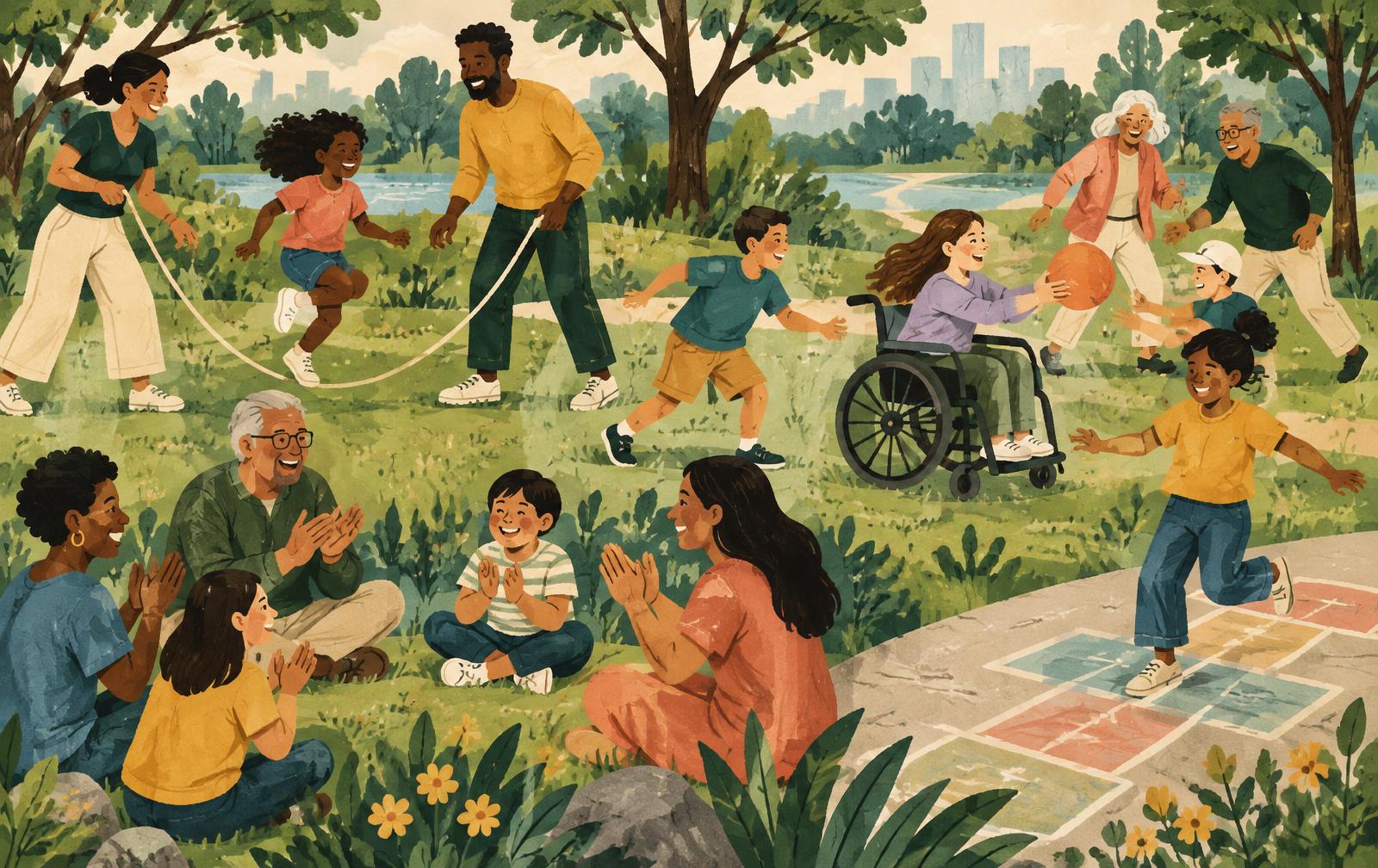
Change the rules, not the invitation.
Walk instead of run. Roll instead of throw. Use sound, touch, a partner, a softer ball or a smaller space. Good play makes room for children, adults, seniors and every way of moving.
Play is living heritage.
Traditional games carry local knowledge, language and memory. Where customs differ, learn from the people who keep them alive and credit what they share.